


Technology has advanced so rapidly this year alone that some are shifting the question from “what manual human tasks and calculations can be aided by AI” to “what entire departments or industries could largely be replaced by AI agents?”
AI’s capabilities are undoubtedly vast. However, when we speak to the second question above, we have to carefully consider the difference between “could” and “should.”
AI In Background Screening
Background screening, especially employment screening, encounters tremendous nuance and is surrounded by legalities. Even the simplest consumer report for employment purposes involves several parties: the consumer, the employer, the consumer reporting agency (CRA), and data providers (i.e., databases, courthouses, etc.). If external agencies such as the Department of Transportation (DOT) regulate certain employment screening programs, these webs expand further. So, it’s not as simple as flipping a switch and leaving the processes on AI autopilot.
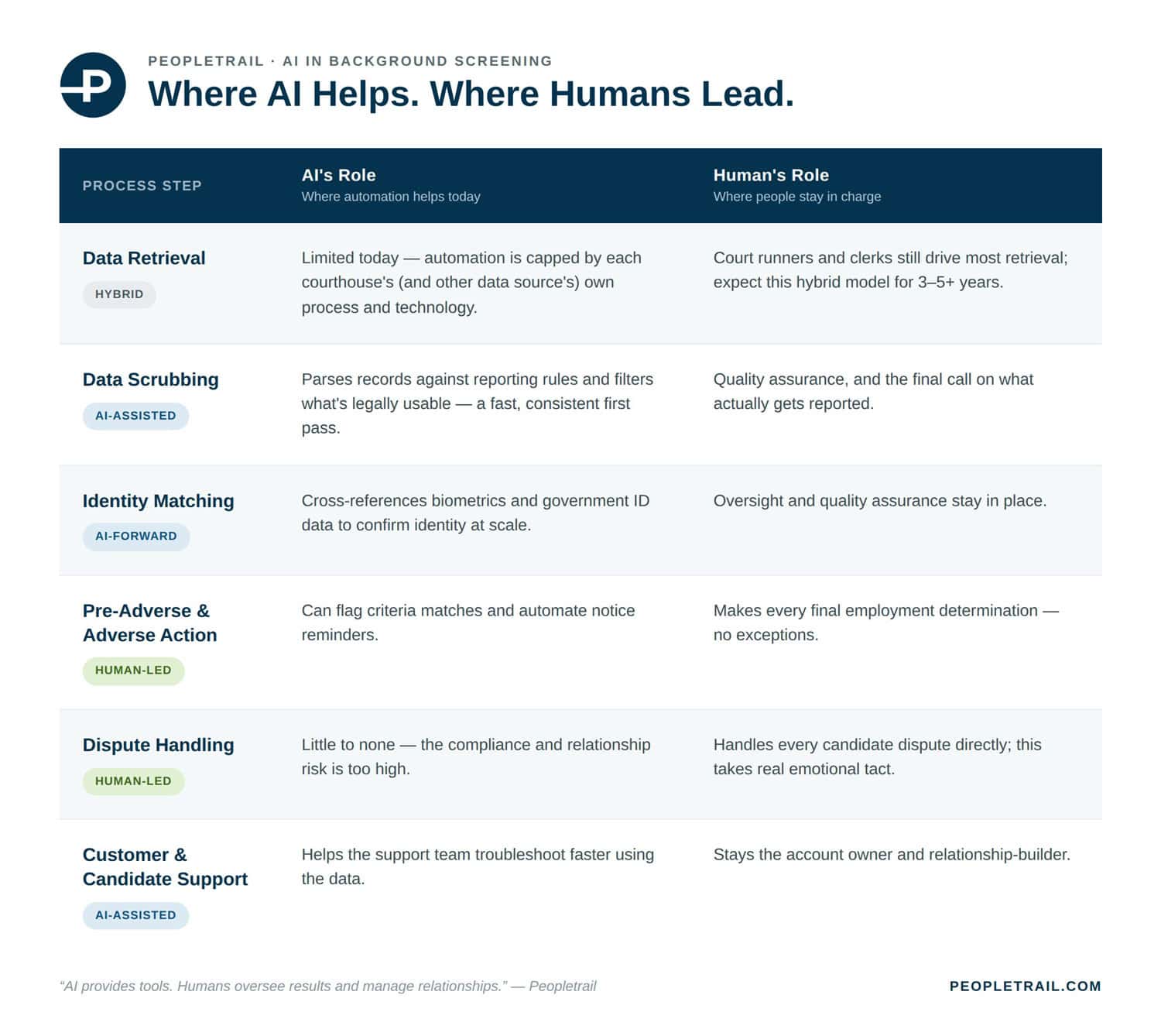
Let’s consider key facets of the screening process and the roles of both human specialists and AI now and in the future.
Data Retrieval
Both AI and human specialists play a role here.
Let’s consider the data provider piece for a moment, specifically county courthouses. County courthouses operate independently and have significant local autonomy. As a result, record-retrieval requirements between any two of the over 3,000 counties nationally can vary considerably.
Many courthouses remain clerk-assisted and rely on manual retrieval processes. To retrieve records from certain jurisdictions, court runners must initiate requests, which courthouse staff must then fulfill. These processes can’t be automated at scale because they depend on each courthouse’s practices and technology. Individual, out-of-network drug testing clinics are another example of this same reality.
While some systems are adopting electronic workflows, the reality is that a hybrid human/AI approach will likely persist for the next 3-5 years, emphasizing the continued need for human oversight in background screening.
Data Scrubbing
AI can play a helpful role here.
The data received from data providers and what is legally reportable for employment are two separate considerations. A courthouse can provide a CRA with a record listing numerous felony convictions, none of which the employer can use in a hiring decision. This, of course, all depends on federal and state-by-state reporting laws and other requirements.
AI is perfectly suited to learn from a set of inputs/criteria and apply them rigidly across systems. If an AI model is given a comprehensive set of reporting inputs, it can parse and filter the data based on established rules. These types of actions are less likely to result in AI hallucinations and can serve as a good first step in processing information.
That said, human quality assurance will remain vital in this process for the foreseeable future. The ultimate decision-making role should still be left to a human expert. This is something that we strongly stand by.
Identity Matching
Another important and emerging role for AI in background screening is identity matching. Cross-referencing personal identifiers against reliable data sources and candidate inputs is becoming very important, while biometrics and government-issued ID cross-comparison are becoming increasingly common. In fact, Peopletrail relies on these tools to improve data integrity and compliance.
While human oversight and quality assurance should still exist, AI has an important role in this area.
Pre-Adverse and Adverse Action Notice Management
This is an area where final decisions should stay firmly human.
While AI can suggest offer withdrawals based on established employer criteria and automate notice reminders, a human specialist should make all final employment determinations. This is the strong industry recommendation.
Because hiring is both a human art and a human science, employers should consider adopting algorithm-assisted, human-driven processes. We believe this will (should) be the standard for the foreseeable future and likely indefinitely.
Dispute Handling
Human experts should handle disputes.
Navigating candidate disputes involves a large degree of emotional tact. Procedurally, AI may be able to execute the appropriate protocols to resolve a dispute; however, a distressed or frustrated candidate with their livelihood at stake will not want to interact with an AI agent. AI oversight in this process poses not only significant compliance risk but also relationship risk between all parties involved.
Customer and Candidate Support
The best combination here is an AI-assisted, human-led dynamic.
At Peopletrail, customer and candidate support is among the most important considerations. While AI is remarkable at using data points to identify and troubleshoot issues, human experts are the clear winners in communication and relationship-building. When it comes to support, we strongly believe in empowering our support team with AI tools, while keeping them firmly in the role of account owner and overseer. While some in the industry are transitioning entirely to automated support, this shift has downsides that may never be fully resolved.
Conclusion
The reality is, technology is better and more efficient at some things than a person is. We have to acknowledge this. Humans will never match a calculator’s speed and accuracy in mathematical computations. However, the reverse is also true. There are many things that should remain indefinitely human. While where this line is drawn depends on who you ask, we believe at Peopletrail that AI provides tools, and humans oversee results and manage relationships. This philosophy has allowed us to adapt to the evolving technological landscape without trading trust for automation.