


In April of 2026, medical cannabis distributed by state-licensed medical programs was officially rescheduled from Schedule I to a Schedule III substance. So, marijuana is now rescheduled, period. End of story, right?
Well, no.
Cannabis remains a complex issue with many legalities and nuances. In the employment world, there is a need for clarity given this changing marijuana landscape, and this article aims to provide some important insights.
Distinguishing Between the Previously Legal and the Newly Legal
Consider the medication Marinol, which has been FDA-approved since 1985.
Marinol is commonly prescribed to treat nausea. An active ingredient in Marinol is dronabinol, which is a synthetic version of delta-9-tetrahydrocannabinol (THC). At a cellular level, it processes almost identically to natural THC.
Thus, for decades there have been legitimate medications, already slated as Schedule III substances, with THC as an active ingredient.
The new federal reclassification has simply placed medical marijuana on the same classification plane as medications like Marinol. The use of these substances is still controlled, requiring due authorization to avoid breach of law. The unauthorized use of cannabis in any form without due authorization is still as prohibited federally as ever. This includes recreational use.
How Does All This Align with Drug Testing Practices?
Let’s first differentiate between DOT and non-DOT screening protocols.
Non-DOT screening programs are governed largely by employer policies and state law. In many cases, it is the employer’s decision whether to test for THC at all and how to handle positives. State-specific laws also impose requirements that must be observed.
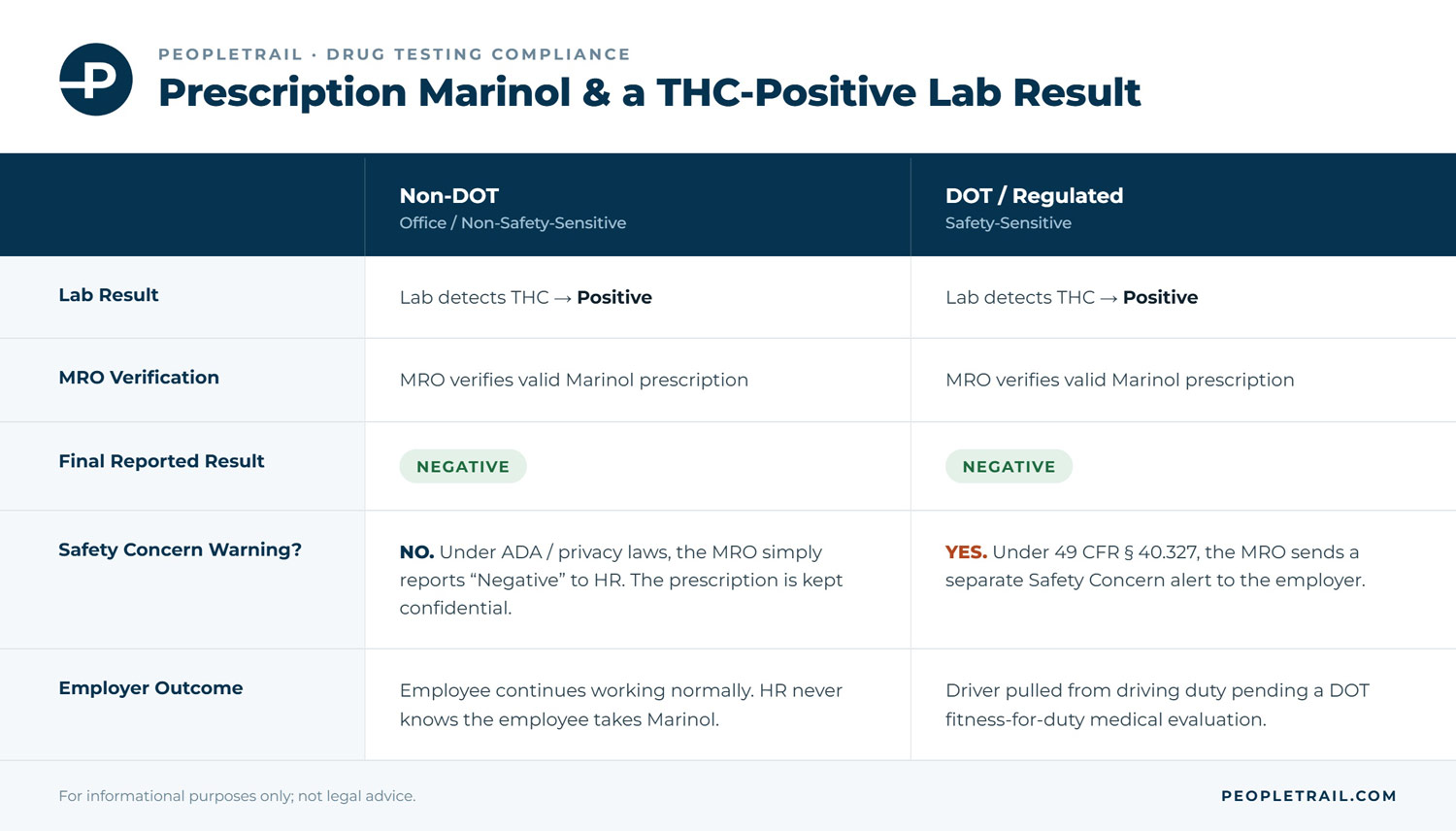
Because prescribed medications such as Marinol will render a test positive for THC, the best practice is to always submit positive THC results for MRO review and treat confirmed Marinol prescriptions as any other legitimate medication. At Peopletrail, every positive sample, DOT regulated or not, is subject to the MRO process.
When it comes to tests regulated by the Department of Transportation (DOT), authorized medical use is not a valid justification for a THC-positive DOT drug test, period. This is not up for employer or state interpretation. However, FDA-approved medications such as Marinol do undergo the MRO process as any other medication.
There is one important caveat.
If the use of a prescribed medication is deemed by the MRO to present a workplace risk, they are required to alert the employer that the employee’s use of a medication could make performing safety-sensitive duties dangerous. This includes Marinol. However, the MRO does not disclose the specific medication or diagnosis details to the employer.
Other FDA-Approved Substances that May Trigger a Positive Drug Test
Amphetamines panel — probably the most common source of legitimate positives:
- Adderall (amphetamine salts): true positive; it literally is amphetamine
- Vyvanse (lisdexamfetamine): metabolizes directly to dextroamphetamine
- Desoxyn (methamphetamine HCl): prescribed for ADHD/obesity, true positive for methamphetamine
- Selegiline/Emsam (MAOI, used for Parkinson’s/depression): metabolizes into small amounts of amphetamine and methamphetamine
- Bupropion (Wellbutrin): well-documented immunoassay cross-reactivity causing false-positive amphetamine screens
- Phentermine (weight-loss medication): structurally similar enough to cross-react on some screens
Opiates panel:
- Codeine, morphine, hydrocodone, hydromorphone: all legitimate prescription opioids that are true positives
- Poppy seed products: not a medication, but a possible confounder on this panel, though this is rare
- Note: standard opiate immunoassays often don’t reliably catch synthetic opioids like oxycodone, fentanyl, or methadone — those usually need separate specific tests
PCP panel:
- Dextromethorphan (in many OTC/prescription cough medicines): cross-reactivity at high doses
- Diphenhydramine (Benadryl): documented false-positive PCP results on some immunoassays
- Venlafaxine (Effexor): well-known false-positive PCP screener, doesn’t confirm
- Ketamine: FDA-approved for anesthesia/esketamine (Spravato) for depression; structurally related, can cross-react
THC panel:
- Marinol/Syndros (dronabinol): as discussed, true positive since it metabolizes to the same THC-COOH
- Epidiolex (CBD): generally shouldn’t trigger THC positives, but trace THC contamination in some CBD products (not FDA-regulated purity) can occasionally cause issues
Cocaine panel:
- Cocaine is very rarely triggered by FDA-approved medications or substances.
Takeaways
To all employers with a drug screening program, we recommend leaving the final decision on non-negative screens up to a certified MRO. As is well understood, there are many FDA-approved medications that can trigger an initial positive drug test result that isn’t ultimately reported to the employer. The new cannabis rescheduling has introduced even more variables that should be understood by all employers with a drug testing program. This landscape will continue to evolve, but knowing the basics is crucial to staying compliant with state and federal regulations. Furthermore, working with a screening expert who knows this landscape and its regulatory nuances can significantly mitigate risk.
DISCLAIMER: NOTHING IN THIS ARTICLE CONSTITUTES LEGAL ADVICE. PLEASE CONFIRM ALL INFORMATION WITH YOUR INTERNAL COMPLIANCE TEAM.